
The Table Had Three Players and a Gap
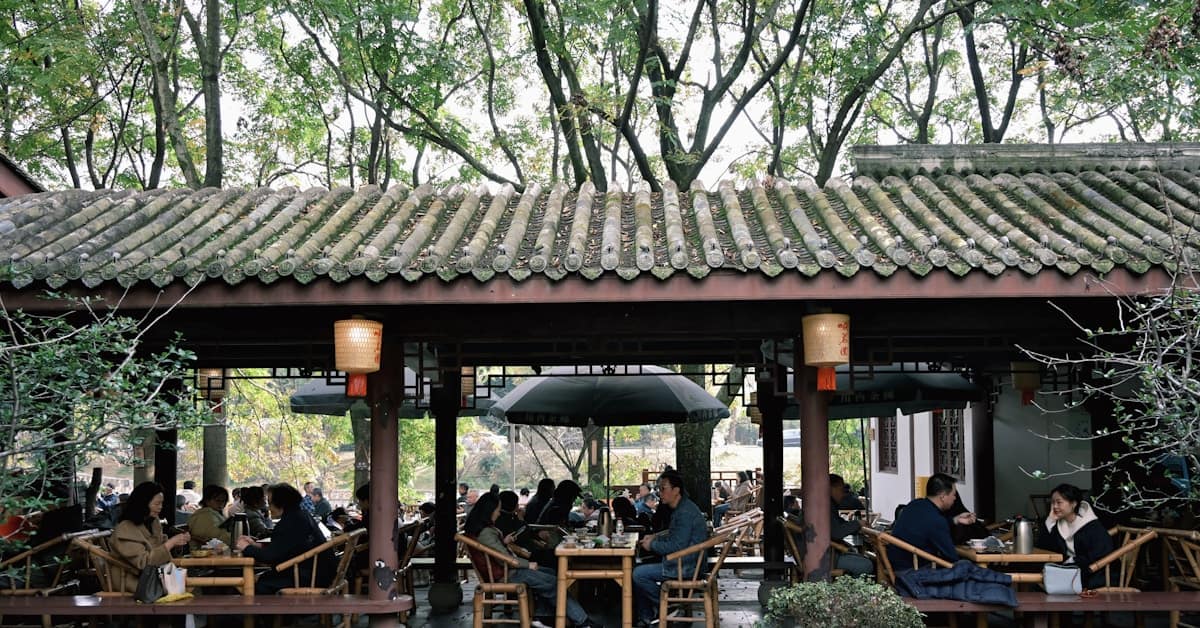
I wasn’t looking for a game. I was cutting through People’s Park in Chengdu — the same park where I’d spent an afternoon doing nothing a few days earlier, as described in my earlier travels — on my way to the south gate, trying to get to the metro before the afternoon rain started. But the path went past a covered pavilion where four portable mahjong tables were set up, and at one of them, an old man was standing up, gathering his jacket and a thermos, saying something to the three remaining players.
One of them — a woman, maybe seventy, in a blue padded vest — pointed at me. Not at me exactly, but at the empty space where the fourth person had been. Then she pointed at me again, more deliberately, and said something I didn’t catch. The man next to her, smaller, with a permanent half-smile, nodded and gestured at the open seat.
I’d been in China long enough to know that refusing an invitation from elderly park people was somewhere between rude and impossible. I sat down.
The Rules I Didn’t Know
This was Sichuan mahjong — no honor tiles, no winds, no dragons. I’d played Cantonese mahjong twice before, badly, in a hostel in Guangzhou. The absence of honor tiles should have made things simpler. It did not. The pace made everything harder.
These three played fast. Not competitively fast — that would have been easier to follow, because competitive players announce everything clearly. This was casual fast, the speed of people who’ve played together for years and don’t need to narrate their moves. A tile was discarded. Someone grabbed it. A set was laid down without being named. The round was over before I’d finished sorting my hand.
I won the second round by accident. I’d been organizing my tiles by suit — all the dots together, all the bamboo together — and I noticed I had three 5-bamboo tiles and a 6-7-8 of dots and a pair of 2-dots. I laid them down and said “Hu?” with the upward inflection of a question.
The woman in the blue vest stared at my hand. Then she stared at me. Then she laughed — not mean, just surprised — and said something to the man with the half-smile, who also laughed. I’d won with the lowest possible scoring hand. The equivalent of winning a poker game with a pair of twos. But a win was a win, and they pushed two one-yuan coins across the table toward me.
The Afternoon I Didn’t Leave
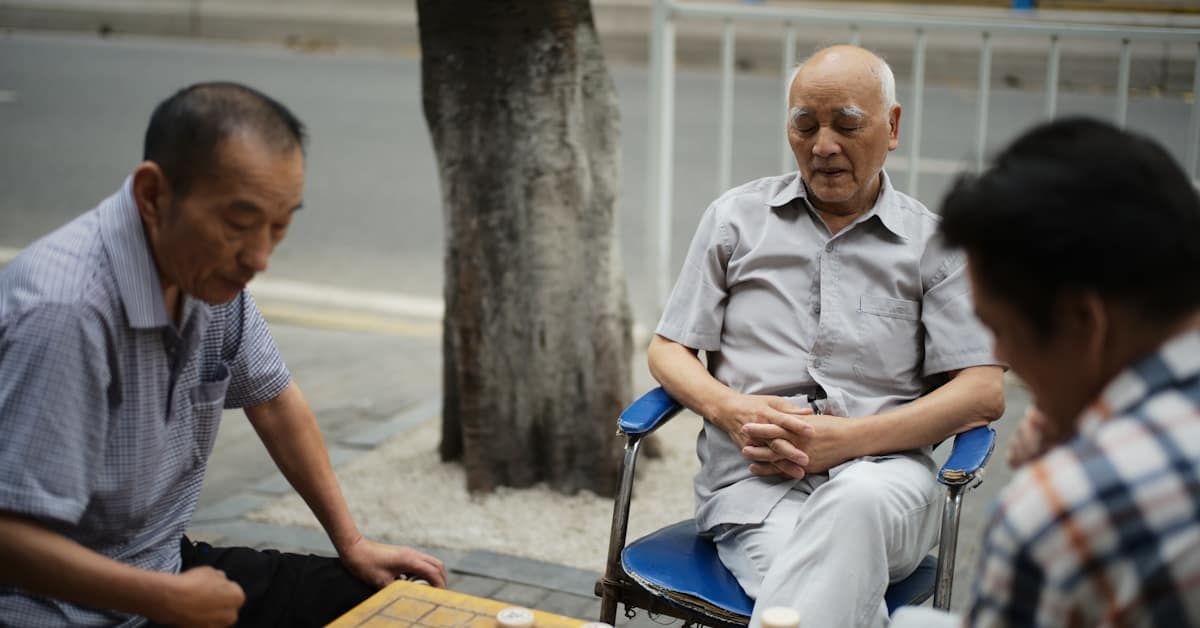
I stayed for three hours. Not because the game was thrilling — I lost most rounds — but because the table had a rhythm that I didn’t want to break. The woman in the blue vest was named something I never caught, so I thought of her as Blue Vest. The small man with the half-smile chain-smoked Long March cigarettes and discarded tiles with a flick that sent them sliding across the felt. The third player, a woman in her sixties with reading glasses on a chain around her neck, barely spoke but played with a precision that suggested she was counting every discarded tile.
Between rounds, they asked me questions. Where was I from. Why was I in Chengdu. Did I like spicy food. Could I use chopsticks. I answered in broken Mandarin and they corrected my tones with the casual authority of people who’d been correcting children’s homework for decades. No one was performing for me. No one was being extra nice because I was foreign. They were just playing their regular Thursday afternoon game and I was the fourth chair.
Blue Vest kept feeding me. Sunflower seeds from a bag she pulled from somewhere. A tangerine. A piece of sponge cake that was slightly stale and perfectly fine. The generosity reminded me of the woman at the Dragon Boat Festival who handed me free zongzi for no reason. I ate everything because turning down food at a mahjong table felt like a violation of something fundamental.
The Round Where I Almost Won Something Real
Hour two. I was down about twelve yuan — nothing, really, the cost of a bowl of noodles. But then I drew a tile that completed a hand I didn’t know the name of: all one suit, no honors (not that Sichuan mahjong has honors), all consecutive sets. It was the best hand I’d ever held.
I said “Hu!” with more confidence this time. Blue Vest looked at my hand and made a sound — not a word, more like an exclamation mark. She counted the fan points out loud, pointing at each set. I didn’t follow the math. The man with the half-smile pulled out a five-yuan note and a one-yuan note and placed them in front of me. Six yuan for one round. More than I’d lost in the previous hour combined.
The reading-glasses woman said something that made Blue Vest laugh. I asked what she’d said. Blue Vest mimed my hand, then mimed surprise, then pointed at me and shrugged. The translation, as far as I could tell: “Even a blind squirrel finds a nut.”
I was okay with that.
What I Got Wrong
I shuffled my tiles too loudly the first few rounds. In China, you shuffle by pushing tiles around the table face-down with both hands — gently, so they make a soft clicking sound. I was pushing too hard and the tiles were clacking like I was angry. Blue Vest reached over and demonstrated the right pressure. Light. Almost lazy.
I also organized my tiles in the wrong order. I put them left-to-right by suit, like playing cards. Chinese players arrange them by function — sets in progress on the left, unpaired tiles on the right. The reading-glasses woman noticed I was rearranging every time I drew and quietly suggested, through gesture, that I group the ones that matched. It took me three more rounds to understand what she meant.
And I forgot to pay. When I won, the losers pushed money to me. When I lost, I was supposed to push money to the winner. Twice I just sat there until the man with the half-smile tapped the table and pointed at the winning hand. I’d been so focused on my own tiles I hadn’t noticed who’d won.
The Hand That Ended the Session
It was getting dark. The pavilion lights came on — bare bulbs strung between the posts. The rain I’d been trying to outrun had arrived, a light drizzle that made the tile surfaces slightly slick. The game had slowed naturally as the afternoon wound down. The cigarettes were running out. The sunflower seeds were gone.
Blue Vest won the last hand. It was a big one — she’d been building it for several rounds, I could tell, because she’d gone quiet in a way that was different from her usual running commentary. When she laid it down, she didn’t even look at the points. She just collected the money, stood up, and started packing the tiles into a cloth bag.
I counted my losses. Down eight yuan total. Less than the cost of the tea I would have bought at a teahouse. I pulled out my phone to pay with WeChat — I’d set it up months ago after following a guide I’d found online — but Blue Vest waved the phone away. She didn’t use WeChat Pay, she said, or at least that’s what I gathered from her gesture. Cash only. I dug out the eight yuan from my pocket.
As I was leaving, the man with the half-smile said something and pointed at the sky. The rain had stopped. He was telling me it was clear now — I could go. I said goodbye the only way I knew how, the phrase I’d learned from my first trip to China: zai jian. Blue Vest corrected my tone. I said it again. She nodded.
I walked out of the park through the south gate, the one I’d been heading for three hours earlier. My fingers smelled like mahjong tiles — that specific plasticky, slightly dusty smell of tiles that have been handled by dozens of hands over dozens of afternoons. I bought a steamed bun from a cart outside the gate. Three yuan. I ate it walking, and I was thinking about the next time I’d be in Chengdu on a Thursday afternoon.