
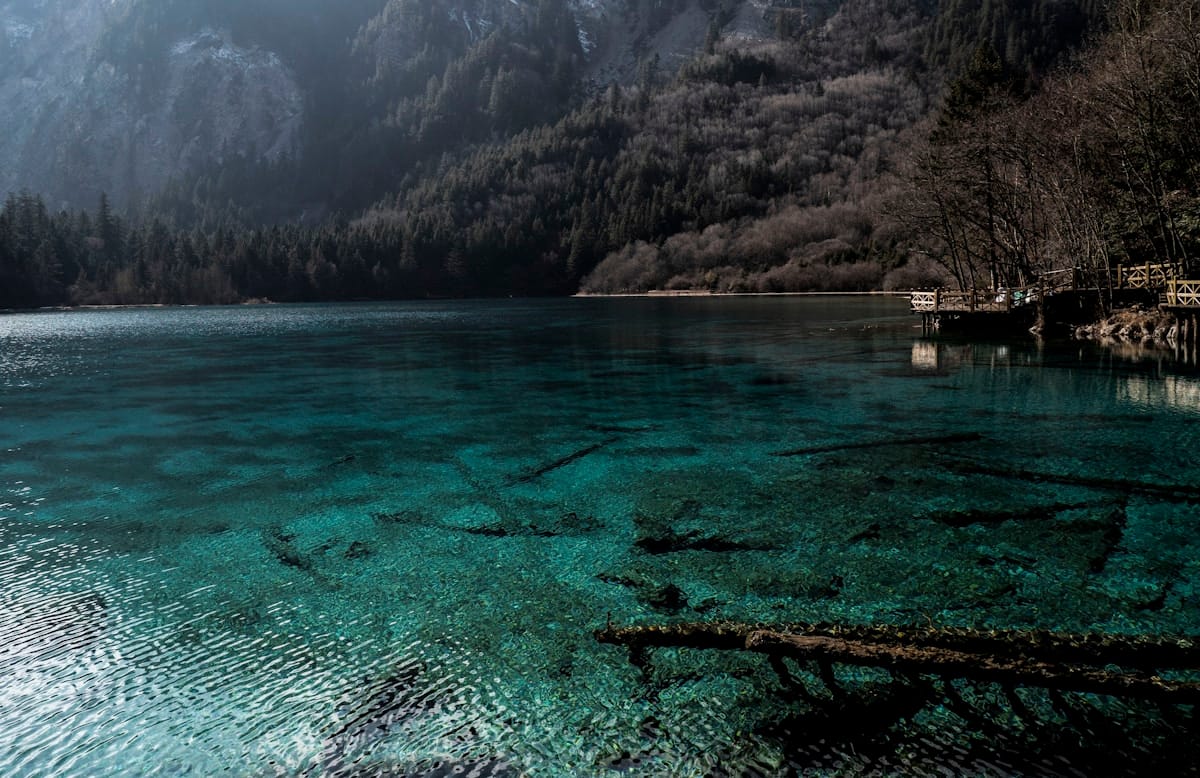
Jiuzhaigou Valley — whose name means "Nine Village Valley" in Chinese — is one of those rare places that actually exceeds the photos. Located in northern Sichuan province at the edge of the Tibetan Plateau, this UNESCO World Heritage site is famous for its turquoise lakes, multi-tiered waterfalls, and snow-capped peaks that reflect in waters so clear you can see fallen trees 20 meters below the surface.
What Makes Jiuzhaigou’s Water So Incredible
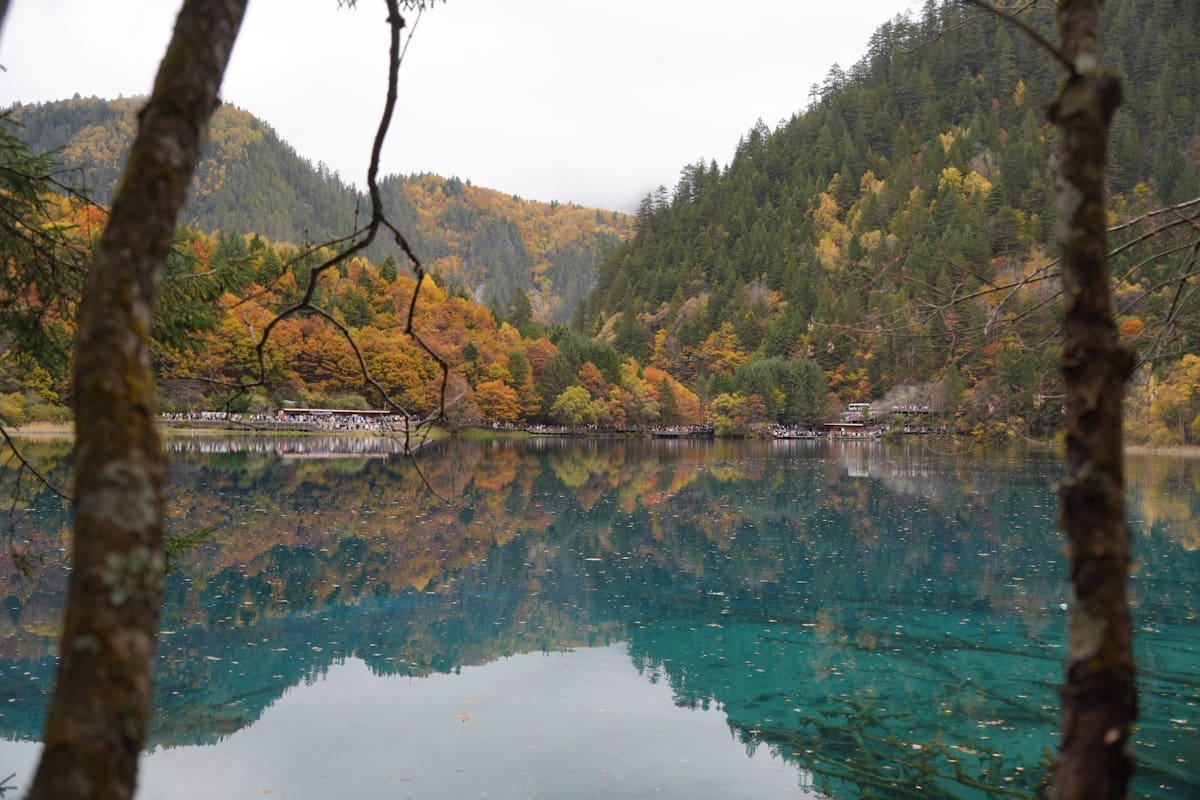
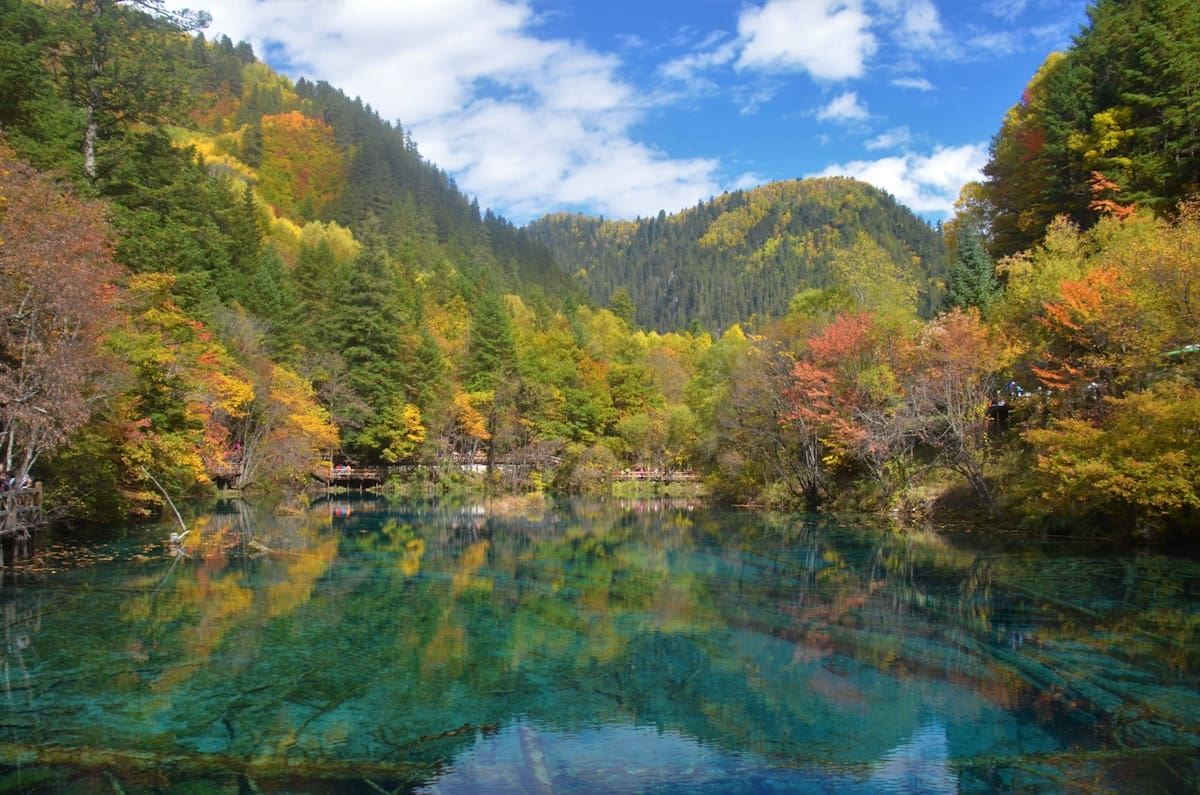
The lakes of Jiuzhaigou don’t look like any water you’ve seen before. The vivid blues and greens come from a combination of mineral-rich travertine deposits, extremely pure glacial meltwater, and the way sunlight penetrates the shallow lakebeds. Over millennia, calcium carbonate has precipitated onto fallen trees and rocks, creating surreal underwater landscapes visible through crystal-clear water. Add autumn foliage reflected on the surface, and you get photographs that look Photoshopped but aren’t.
The valley sits at 2,000-4,500 meters above sea level, creating distinct ecological zones from mixed forests to alpine meadows. Summer travelers should also weigh the rainfall — northern Sichuan gets soaked in July and August, the same trade-off I walk through in my China summer travel guide before heading to the alpine zones. It’s home to endangered species including the giant panda, golden snub-nosed monkey, and Sichuan takin — though most visitors will only spot the park’s abundant birdlife and perhaps a shy Tibetan macaque.
The Y-Shaped Valley: A Complete Route Guide
Jiuzhaigou’s scenic area follows a Y-shaped valley with three main branches. Park shuttle buses run continuously and are included in the entrance fee (¥169 in peak season, ¥80 in low season). Here’s how to tackle it efficiently:
Rize Gully (Right Branch)
Start here first thing in the morning — these are the park’s crown jewels:
- Arrow Bamboo Lake: The highest large lake in the valley, surrounded by bamboo groves where pandas were historically spotted.
- Panda Lake: Striking blue-green water with fish visible through the surface. The lake partially freezes in winter, creating ethereal ice patterns.
- Five-Flower Lake: The undisputed star of Jiuzhaigou. The shallow travertine floor creates a kaleidoscope of turquoise, emerald, and sapphire. Go mid-morning when the sun is high enough to illuminate the entire lakebed.
- Pearl Shoal Waterfall: A 310-meter-wide cascade of water tumbling over travertine ledges — one of the widest waterfalls in China.
Zechawa Gully (Left Branch)
- Long Lake: At 3,060m, this is Jiuzhaigou’s highest and deepest lake. It’s surrounded by snow-capped peaks year-round and freezes solid in winter.
- Five-Color Pond: The smallest but most intensely colored pool in the park. Despite being just 5 meters deep, its kaleidoscopic blues are unmatched.
Shuzheng Gully (Main Valley)
- Nuorilang Falls: A magnificent 320-meter-wide curtain of water, and the park’s most photographed waterfall. In winter, it transforms into a massive frozen ice sculpture.
- Shuzheng Lakes: A chain of 19 terraced lakes stepping down the valley, with traditional Tibetan watermills along the boardwalk.
Practical Tips for Visiting Jiuzhaigou
- Getting there from Chengdu: The fastest option is flying to Jiuzhai Huanglong Airport (JZH) — about 1 hour, then a 1.5-hour drive to the park. By road, it’s an 8-hour journey through dramatic mountain scenery on the G213 highway. For the adventurous, our West Sichuan road trip covers routes that connect Chengdu to this region.
- Best time to visit: Late October for peak autumn colors — the golden larch trees against turquoise lakes are otherworldly. December-February for frozen waterfalls and snow-dusted forests with far fewer tourists. Avoid Chinese National Day (Oct 1-7) at all costs.
- Altitude: The valley floor is 2,000-3,100m. Most visitors have no issues, but stay hydrated and ascend gradually. Free oxygen stations are available throughout the park.
- Tickets: Book online in advance through the official Jiuzhaigou website. Daily visitor numbers are capped, and same-day tickets often sell out during peak seasons. The booking site is Chinese-only — load it in a browser with translation on, and pair it with an alternative to Google Maps since Google fails inside the park.
- Where to stay: The town of Zhangzha, just outside the park entrance, has hotels at all budget levels. For a more immersive experience, stay at a Tibetan-style guesthouse in one of the nearby villages.
- Food: Try yak jerky, butter tea, and Tibetan barley bread from vendors inside the park. Bring snacks — food options inside are limited and pricey.
For your gateway city, see our Chengdu travel guide — the natural starting point for any Jiuzhaigou adventure.
Combine Jiuzhaigou with Huanglong
Most travelers pair Jiuzhaigou with Huanglong National Park, located just 2 hours away. If Jiuzhaigou is about lakes, Huanglong is about terraced pools — a 3.6-kilometer-long cascade of golden travertine terraces descending a mountain valley, fed by mineral-rich hot springs. The pools shift from turquoise to emerald to amber depending on the season and sunlight angle, and the whole formation looks like a dragon winding down the mountainside (hence the name "Yellow Dragon").
Huanglong sits at a higher elevation than Jiuzhaigou (3,200-3,576m), so altitude sickness is a real concern. Take the cable car up and walk down — it’s much easier on your lungs. Entry is ¥170 (peak season). Combined with Jiuzhaigou, this makes for an unforgettable 3-4 day trip from Chengdu that showcases the very best of Sichuan’s alpine landscapes.
Insider tip: If you can only choose one season, pick late October. The autumn foliage at both parks peaks simultaneously, and the golden larch forests with turquoise lakes and terraced pools create some of the most photogenic landscapes in all of Asia. Just be ready for the crowd math — I broke that down in my October Jiuzhaigou diary after the lake that finally fixed it.
Three more notebooks from the same swing through southwest China: